
18 March 2026
Understanding Weight Management Science: The TRMe System

The UK’s Weight Problem — And Why Quick Fixes Keep Failing
Let’s be honest about where we stand. According to the Health Survey for England, roughly 64% of British adults are now classified as overweight or obese. That puts the UK among the highest rates in Western Europe, well above the EU average of around 50.6%. These aren’t abstract numbers — they represent millions of people who’ve tried, struggled, and often given up.
Overweight Adults in the UK vs EU Average (Eurostat 2022)
Source: Health Survey for England / Eurostat 2022 EHIS
We’ve all done the January reset. The meal prep Sunday that lasts until Wednesday. The gym membership that sees heavy use in the first three weeks. British culture doesn’t make it easy either — the pub lunch, the Friday takeaway, portion sizes that have crept up steadily over the past two decades. Add in a climate that genuinely discourages outdoor activity for about five months of the year, and you start to see why willpower alone isn’t cutting it.
The NHS recommends gradual weight loss of 0.5 to 1 kg per week as the safest, most sustainable approach. Yet the weight loss industry keeps pushing rapid results, extreme restriction, and products that promise miracles. What’s shifting now — slowly, thankfully — is a move toward evidence-based supplementation. Not magic pills, but targeted nutritional support that works alongside sensible eating. That’s the territory worth paying attention to.

The Science of Why Diets Fail
If dieting worked the way most people think it does, we’d have solved this decades ago. Eat less, move more, lose weight. Simple maths. Except the body isn’t a calculator — it’s an adaptive system that actively fights back against caloric restriction.
The first problem is metabolic adaptation. When you cut calories significantly, your resting metabolic rate drops. A landmark study published in the journal Obesity (Fothergill et al., 2016), which followed contestants from the TV show The Biggest Loser, found that participants’ metabolisms had slowed dramatically six years after the competition — burning an average of 500 fewer calories per day than expected for their body size. Their bodies had essentially recalibrated to resist further weight loss and encourage regain.
Then there’s the lean tissue problem. Research published in the American Journal of Clinical Nutrition has shown that on traditional calorie-restricted diets, between 20% and 40% of total weight lost can be lean tissue — muscle, not fat. This matters enormously because muscle is metabolically active tissue. Lose it, and your basal metabolic rate drops further, creating a vicious cycle where maintaining weight loss becomes progressively harder.
Your gut microbiome plays a larger role than most people realise. A 2019 review in the journal Nutrients found that the composition of gut bacteria differs significantly between lean and obese individuals, and that these microbial communities influence everything from how efficiently you extract calories from food to how your body stores fat. Poor digestive health doesn’t just cause discomfort — it can directly undermine weight management efforts.
The liver is another overlooked factor. Non-alcoholic fatty liver disease (NAFLD) now affects approximately 25% of the European population, according to the European Association for the Study of the Liver. When liver function is compromised, fat metabolism slows. The liver is your primary fat-processing organ, and if it’s struggling under its own fat burden, breaking down dietary and stored fat becomes significantly less efficient.
Finally, there’s the blood sugar cycle. Refined carbohydrates cause rapid glucose spikes followed by sharp drops, triggering hunger, cravings, and the kind of mid-afternoon energy crash that sends you straight to the biscuit tin. It’s not a lack of discipline — it’s biochemistry. Stabilising blood sugar is one of the most effective ways to reduce cravings, yet most diet plans barely address it.
The common thread? Weight management isn’t one problem. It’s four or five problems happening simultaneously, and addressing only one of them — say, just cutting calories — while ignoring the others is why so many approaches deliver short-term results and long-term frustration.
A Different Approach — Addressing Multiple Factors Simultaneously
Once you accept that weight management involves several interconnected systems, the logical next step is obvious: you need to support all of them at once. Not with a single ingredient or a single strategy, but with a coordinated approach that targets the key failure points.
In our experience, the most promising framework we’ve come across addresses four areas simultaneously:
- Metabolism support during caloric restriction — helping the body maintain energy expenditure even when eating less, so you don’t hit the metabolic wall that derails most diets after 6–8 weeks.
- Appetite and blood sugar regulation — stabilising glucose levels to reduce cravings and support satiety between meals, which tackles the willpower problem at its biochemical root.
- Digestive health — supporting efficient nutrient absorption and gut comfort, because a healthy digestive system processes food more effectively and contributes to overall metabolic health.
- Liver function and fat metabolism — supporting the organ most directly responsible for breaking down and processing fat, particularly relevant given how widespread sub-clinical liver issues have become.
This isn’t about stacking random supplements. It’s about choosing ingredients with genuine scientific backing — ideally with EU-approved health claims — and combining them in a way that addresses the real reasons diets fail. We’ve been researching this space for a while now, and the shift from single-ingredient supplements to multi-target systems is one of the more encouraging developments in evidence-based weight management.
How ageLOC TRMe Applies This Science
This is where Nu Skin’s ageLOC TRMe system comes in, and honestly, it’s one of the more thoughtfully designed weight management programmes we’ve looked at. Rather than relying on a single product or ingredient, TRMe is a four-product system where each component targets one of the pillars described above.
The 4 Pillars of ageLOC TRMe
MyGoal — Metabolism and Energy Support
MyGoal is the foundation product, built around glucomannan (konjac fibre). This is one of the few weight management ingredients that carries an officially approved EU health claim: glucomannan contributes to weight loss in the context of an energy-restricted diet, when consumed as a daily intake of 3g in three doses of 1g each, with 1–2 glasses of water before meals. It works by expanding in the stomach, promoting a feeling of fullness.
Beyond glucomannan, MyGoal includes vitamins C, B6, and B12, which contribute to normal energy-yielding metabolism — an EU-approved claim that’s particularly relevant during caloric restriction, when energy levels tend to dip. Vitamin B6 also contributes to the regulation of hormonal activity, supporting the body’s adjustment during dietary changes.
MyEdge — Appetite and Blood Sugar Support
MyEdge targets the blood sugar roller coaster that derails so many diet attempts. It contains white mulberry leaf extract, traditionally used for blood sugar support, alongside carob extract, which helps promote feelings of appetite satisfaction and satiety. The inclusion of chromium is notable — chromium contributes to the maintenance of normal blood glucose levels, another EU-approved health claim.
We’ve found this is the component that people notice most quickly in daily use. When blood sugar stays more stable throughout the day, the 3pm craving disappears — and that alone can make a meaningful difference to daily calorie intake without requiring additional willpower.
InnerNu — Digestive Comfort
InnerNu focuses on the gut with artichoke leaf extract and ginger root extract. Artichoke leaf has a long history of traditional use for digestive comfort, while ginger root may help support normal digestive function. This is the most understated product in the system, but given what we know about the gut’s role in weight management, supporting digestive health during dietary changes makes sound sense.
A word of caution: if you have existing digestive conditions, it’s worth checking with your GP before adding any new supplement to your routine.
RealMe — Liver and Fat Metabolism Support
RealMe rounds out the system with turmeric extract, which has an approved claim in the EU context: it prevents fat accumulation and facilitates breakdown of fats by the liver. Given the prevalence of liver-related metabolic issues discussed earlier, this is a genuinely practical addition rather than just padding out the product range.
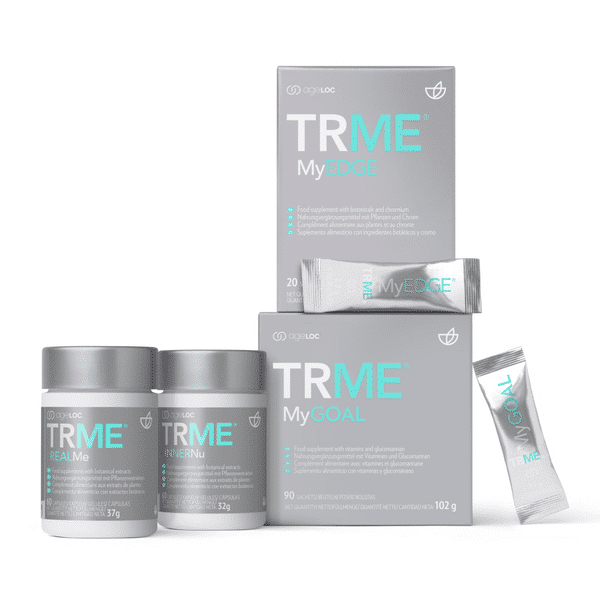
ageLOC TRMe Weight Management Kit

Practical Guide — How to Start
The TRMe system is designed to integrate into your existing routine rather than replacing meals or requiring dramatic lifestyle overhauls. Here’s what a typical day looks like:
Morning (before breakfast): Take MyGoal with 1–2 large glasses of water. The glucomannan needs adequate water to expand properly — this step matters more than people think. Follow with your normal breakfast.
Midday (before lunch): Second dose of MyGoal, again with plenty of water. Take MyEdge alongside it to support steady blood sugar through the afternoon — that vulnerable window when most snacking happens.
Evening (before dinner): Third dose of MyGoal with water. Take InnerNu to support digestive comfort. RealMe can be taken with any meal.
The system comes with a Body Balance Guide that provides more detailed daily guidance. It’s straightforward and doesn’t require calorie counting or food exclusion lists. The principle is simple: eat sensibly, support your body’s natural processes, and let the four pillars address the areas where most diet plans fall short.
Set realistic expectations. This isn’t a rapid transformation programme — it’s a sustainable approach. Most people find they settle into the routine within the first week, and the Body Balance Guide helps you track progress without obsessing over daily weigh-ins. TRMe works alongside your normal meals; it’s supplementation, not substitution.
One thing we genuinely appreciate: there’s no proprietary shake or meal replacement involved. You eat real food, ideally following the kind of balanced diet the NHS already recommends, and TRMe supports the metabolic, digestive, and appetite-related factors that make sticking to that diet easier.

Frequently Asked Questions
Is the TRMe system suitable for vegans?
MyGoal, MyEdge, and RealMe all carry V-Label certification, making them suitable for vegans. InnerNu uses a capsule that contains gelatin, so it’s vegetarian but not vegan. If you follow a fully vegan diet, you could use the other three products and look for an alternative digestive support. Nu Skin has been transparent about the V-Label status on packaging, which we appreciate.
How long before I notice any difference?
This varies considerably from person to person and depends on your starting point, diet, and activity levels. The glucomannan in MyGoal may help with satiety from the first use, since it’s a physical mechanism (fibre expanding in the stomach). For broader changes, most users find the 4–6 week mark is when they begin to notice meaningful shifts in energy, appetite patterns, and how their clothes fit. We’d suggest committing to at least one full month before judging whether it’s working for you.
Can I use individual TRMe products separately, or do I need the full kit?
The products are designed to work as a system, and the science behind TRMe is based on addressing all four pillars simultaneously. That said, the products can technically be used individually. If budget is a consideration, MyGoal (glucomannan plus metabolism vitamins) is arguably the strongest standalone product, since it carries the most robust EU-approved health claim. But honestly, the value of the system is in the combined approach — dropping one pillar weakens the overall strategy.
What’s the difference between TRMe and the ageLOC M-Bars?
The M-Bars are a separate product — they’re meal replacement bars designed for calorie control, not a supplement system. TRMe doesn’t replace meals at all. You eat your normal food and take TRMe products before meals to support metabolism, appetite, digestion, and liver function. Some people use M-Bars alongside TRMe for convenience on busy days (replacing one meal), but they serve different purposes. TRMe is the system; M-Bars are an optional complement.
Are there any side effects I should know about?
Glucomannan can cause mild bloating in the first few days as your body adjusts to the increased fibre intake — this typically settles within a week. Always take it with plenty of water, as directed. If you’re on medication for blood sugar or blood pressure, speak with your GP before starting, as some ingredients may interact. Pregnant or breastfeeding women should avoid using weight management supplements without medical advice.
If you’re ready to move beyond the diet cycle and try something grounded in actual nutritional science, the TRMe system is worth a serious look.
Explore the TRMe Weight Management Kit →
Product information sourced from official Nu Skin product documentation and EU-approved health claims register. Sources referenced: Health Survey for England (NHS Digital), Eurostat EHIS 2022, Fothergill et al. (2016) Obesity, European Association for the Study of the Liver NAFLD guidelines.
Food supplements should not be used as a substitute for a varied and balanced diet and a healthy lifestyle. Do not exceed the recommended daily dose. Consult your healthcare provider before starting any new supplement programme.
NuBest Skin is an Independent Nu Skin Brand Affiliate. This website is independently operated and is not produced, endorsed, or approved by Nu Skin Enterprises, Inc.