Authorised Independent Nu Skin Distributor
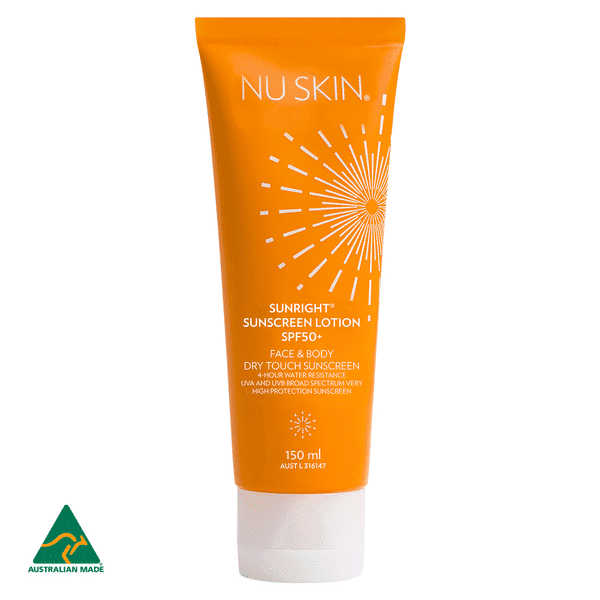
Sunright® Sunscreen Lotion SPF 50+ (AU)
Product Description
Sunright® Sunscreen Lotion SPF 50+ is a broad-spectrum sunscreen meeting the Australian and New Zealand standard AS/NZS 2604:2021 — the benchmark framework that defines what SPF 50+ means in Australia and how it must be tested and verified. SPF 50+ filters approximately 98% of UVB radiation; its broad-spectrum rating means it also blocks UVA across the range responsible for photoageing and DNA damage. In a country where Cancer Council Australia reports over 17,000 melanoma diagnoses annually and where the Bureau of Meteorology regularly records UV Index 11–14 (extreme) during summer, daily SPF 50+ broad-spectrum coverage is not discretionary. All products ship from the official Nu Skin Australia warehouse.
What the AS/NZS 2604:2021 Standard Actually Means
AS/NZS 2604:2021 is one of the world's most demanding sunscreen standards — stricter than the EU's recommendation framework and applied as mandatory compliance rather than voluntary guidance. It specifies minimum UVA protection requirements (not just UVB SPF rating), water resistance testing methodology, photostability requirements, and label claim verification. A sunscreen sold in Australia as SPF 50+ broad-spectrum must have been independently tested against these criteria and, if it carries therapeutic claims, listed with the Therapeutic Goods Administration (TGA).
The practical implication for consumers is straightforward: if a sunscreen is marketed and sold in Australia with an SPF claim, it has been verified to that claim through a standardised process. The Sunright Sunscreen Lotion meets this standard and is manufactured to the quality controls required for TGA-listed therapeutic goods.
SPF 50+ vs SPF 30: The Numbers Behind the Difference
SPF 30 filters 96.7% of UVB. SPF 50+ filters 98%. On a single day's exposure, this difference appears small. Across a lifetime of daily Australian sun exposure — school pickups, lunch breaks, weekend sport, driving — the cumulative UV dose difference is significant. The Cancer Council's position is clear: SPF 50+ is recommended over SPF 30 for all regular outdoor exposure in Australia. The 1.3 percentage point difference in UVB filtration translates to meaningfully lower lifetime UV dose at Australian UV intensity levels.
UVA protection, which broad-spectrum covers, matters for a different reason than UVB. UVB causes sunburn and is the primary short-term damage signal; UVA penetrates deeper into the dermis, causes DNA damage without visible sunburn, and is the dominant driver of photoageing (collagen breakdown, sunspots, loss of elasticity) over decades. No sunscreen that only protects against UVB adequately addresses the full spectrum of UV-related skin damage in Australia's UV environment.
Key Ingredients
Broad-Spectrum UV Filter System — a combination of UV-absorbing agents providing protection against both UVA and UVB across the full spectrum required under AS/NZS 2604:2021. The specific filter combination is listed on the product label. A combination filter approach typically addresses different wavelength ranges more completely than single-filter systems, ensuring no gaps in protection across the UVA/UVB spectrum.
Water-Resistant Base — the formula maintains its protective film during swimming and sweating for the duration specified on the label. Water resistance in Australian sunscreens is tested under AS/NZS 2604:2021 methodology, which involves water immersion periods to verify SPF retention. Reapplication after towel drying or prolonged water exposure is required regardless of the water resistance rating — physical abrasion removes the protective film.
Moisturising Agents — the formula includes humectants and emollients that counteract the drying effect some sunscreen formulations produce. Maintaining skin hydration under a sunscreen layer supports both comfort during extended wear and skin barrier function, which is relevant for Australians applying sunscreen as the final step of a daily skincare routine.
Sunright SPF 50+ vs Other Market Options
All broad-spectrum SPF 50+ sunscreens sold in Australia are tested to AS/NZS 2604:2021 — this is the common baseline. The differences between sunscreen products lie in their filter technology, formulation texture, skin feel, and any additional skin-supporting ingredients.
| Consideration | Sunright SPF 50+ | Cancer Council Daily SPF 50+ | La Roche-Posay Anthelios | Ultra Violette Lean Screen |
|---|---|---|---|---|
| Standard | AS/NZS 2604:2021 | AS/NZS 2604:2021 | AS/NZS 2604:2021 | AS/NZS 2604:2021 |
| Filter type | Chemical/physical combination | Zinc oxide + titanium dioxide (physical) | Mexoryl SX + Mexoryl XL (photostabilised chemical) | Hybrid mineral-chemical |
| Finish | Lotion — blends into skin | Tends to leave white cast (physical filters) | Lightweight elegant texture | Lightweight, skin-first formulation |
| Water resistant | ✓ | ✓ | ✓ | ✓ |
| Broad spectrum | ✓ | ✓ | ✓ (high UVA emphasis) | ✓ |
| Nu Skin system integration | ✓ — pairs with Nu Skin skincare | ✗ | ✗ | ✗ |
All four products provide valid SPF 50+ broad-spectrum protection under the same Australian standard. Choosing between them is primarily a matter of formulation texture, finish preference, and whether integration with a broader skincare routine matters. The Sunright Sunscreen Lotion is the natural pairing for existing Nu Skin skincare users — applied as the final skincare step before the rest of the day begins.
Daily Application Context for Australian Skin
The Australian Radiation Protection and Nuclear Safety Agency (ARPANSA) records UV Index values above 3 — the threshold where sun protection is recommended — on a majority of days in every Australian capital city, year-round. In Darwin, Cairns, and the Queensland coast, UV exceeds 3 every single day of the year. In Sydney, Melbourne, and Adelaide, the period from September through April typically sees daily UV above 3 for most of the day.
For the majority of Australians, this means daily sunscreen is not a beach activity product — it is a daily skincare essential. Applying SPF 50+ as the final morning skincare step, regardless of planned outdoor time, addresses the cumulative UV exposure from walking, driving, and incidental outdoor moments that collectively drive the majority of lifetime UV damage.
Who It's For
✅ Best suited for: Anyone seeking daily broad-spectrum SPF 50+ protection meeting the Australian AS/NZS 2604:2021 standard. Existing Nu Skin skincare users looking for a sunscreen that integrates as the final step of their routine. Those in high-UV regions (Queensland, NT, WA) where year-round daily SPF 50+ is particularly important. People with UV-sensitive skin who require reliable broad-spectrum protection with moisturising properties.
⚠️ Less suited for: Those specifically seeking tinted or colour-correcting SPF formulas — this is an untinted lotion. Those who require a certified mineral/physical-only formula (Cancer Council's zinc-only option is more appropriate for this requirement). Those who prefer a gel or dry-touch finish for very oily skin.
💡 Pairs well with: The Sunright Insta Glow Tinted Self-Tanning Gel (AU$36) — self-tan gives a UV-free colour while this sunscreen provides real UV protection. Apply sunscreen daily over a self-tan base for the complete sun-safe Australian summer routine. Any Nu Skin facial serum or moisturiser — apply Sunright as the outermost skincare layer before leaving the house.
Works With
Sunright Insta Glow Tinted Self-Tanning Gel — the self-tan gel provides cosmetic colour without UV exposure; this sunscreen provides the actual UV protection. Apply sunscreen over a developed self-tan base each morning. The two products serve different functions — one cosmetic, one therapeutic — and are designed to be used together as the complete Sunright sun safety pair.
How to Use
Apply generously 20 minutes before sun exposure — the Cancer Council recommends approximately one teaspoon (5ml) per limb, one for the front torso, one for the back, and one for the face and neck. That is roughly 35ml for a full-body application. Reapply every two hours, or immediately after swimming, sweating, or towel drying. Even water-resistant sunscreens lose effectiveness with physical abrasion and water exposure.
For daily facial use under makeup, apply as the last step of your skincare routine, before primer or foundation. If using alongside other Nu Skin skincare products, apply Sunright as the final skincare step — sunscreen should always be the outermost layer.
Frequently Asked Questions
What does AS/NZS 2604:2021 compliance actually guarantee?
It guarantees that the product has been independently tested and verified to deliver SPF 50+ UVB protection and broad-spectrum UVA coverage under standardised Australian testing methodology. Products carrying this compliance have met mandatory labelling and testing requirements — the SPF rating on the label is verified, not self-declared.
How much sunscreen do I actually need to apply?
Most people significantly under-apply. The Cancer Council's guideline of one teaspoon per body area equates to approximately 35ml for a full-body application. Under-application reduces effective SPF — applying half the recommended amount can reduce protection by more than half due to the non-linear relationship between film thickness and protection.
Do I need to reapply if I'm staying indoors most of the day?
For limited outdoor exposure (walking to and from a car, brief outdoor moments), a single morning application is typically adequate. For any extended outdoor activity — more than 20 minutes of direct sun exposure — reapplication every two hours is required to maintain protection. UV Index 3+ occurs in most Australian cities from before 10am to after 3pm in summer.
Can I apply this over or under moisturiser?
Apply after moisturiser and before any makeup or primers. Sunscreen is always the final skincare step before leaving the house. Applying it before moisturiser means the moisturiser is sitting over the sunscreen film, potentially diluting it or creating an uneven barrier.
Is this safe for daily use on the face?
Yes. The formula includes moisturising agents and is designed for daily facial use. For those with very sensitive or acne-prone skin, patch test on the inner arm before full facial application.
Is SPF 50+ meaningful in winter in Australia?
Yes, in most Australian cities. ARPANSA data shows UV Index above 3 on the majority of winter days in Brisbane, Sydney, Perth, and Adelaide. In Melbourne and Hobart, winter UV occasionally drops below 3 but exceeds it during midday hours on most winter days. Winter clouds do not significantly block UV — up to 80% of UV penetrates cloud cover.
How does this sunscreen compare to Cancer Council sunscreens available at chemists?
Both meet AS/NZS 2604:2021 and provide verified SPF 50+ broad-spectrum protection. The key difference lies in formulation: Cancer Council's everyday formulas typically use physical filters (zinc oxide, titanium dioxide) that may leave a white cast on deeper skin tones. Sunright uses a combination filter approach for a lotion finish that blends without residue — a formulation texture difference rather than a protection difference.
Does this sunscreen expire?
Yes. The expiry date is printed on the packaging. An expired sunscreen should not be relied upon for SPF protection — UV filter chemistry degrades over time, and TGA compliance testing is conducted on in-date product. Store in a cool, dry place away from direct heat and sunlight, which accelerates degradation.
Important Information
Individual results may vary. Sunscreen is only one part of sun protection — the Cancer Council recommends combining sunscreen with protective clothing, hats, shade, and sunglasses (Slip, Slop, Slap, Seek, Slide). No sunscreen provides 100% UV protection. Reapply as directed. Avoid prolonged sun exposure. This product is listed with the TGA as a sunscreen product and complies with AS/NZS 2604:2021.
Sources & References
- Cancer Council Australia — Sunscreen Position Statement 2022. cancer.org.au
- ARPANSA — UV Index data and sun protection guidelines. arpansa.gov.au
- Bureau of Meteorology — UV Index forecasts for Australian cities. bom.gov.au
- Standards Australia — AS/NZS 2604:2021 Sunscreen Products — Evaluation and Classification. standards.org.au
- Nu Skin Enterprises — Sunright Sunscreen Lotion SPF 50+ product information. nuskin.com/au
NuBest Skin is an Independent Nu Skin Brand Affiliate. This website is independently operated and is not produced, endorsed, or approved by Nu Skin Enterprises, Inc.
Author: NuBest Skin Editorial Team
Why Buy from NuBest Skin?
No registration needed — shop and purchase directly, no account setup required.
Shipped from official Nu Skin warehouse — 100% authentic, factory-sealed products with full warranty.
Competitive pricing — we offer great value on authentic Nu Skin products.
Nu Skin product purchasing channels for Australia -- relationship, invoice, warranty, warehouse fulfilment, and marketplace-risk guidance.