Authorised Independent Nu Skin Distributor
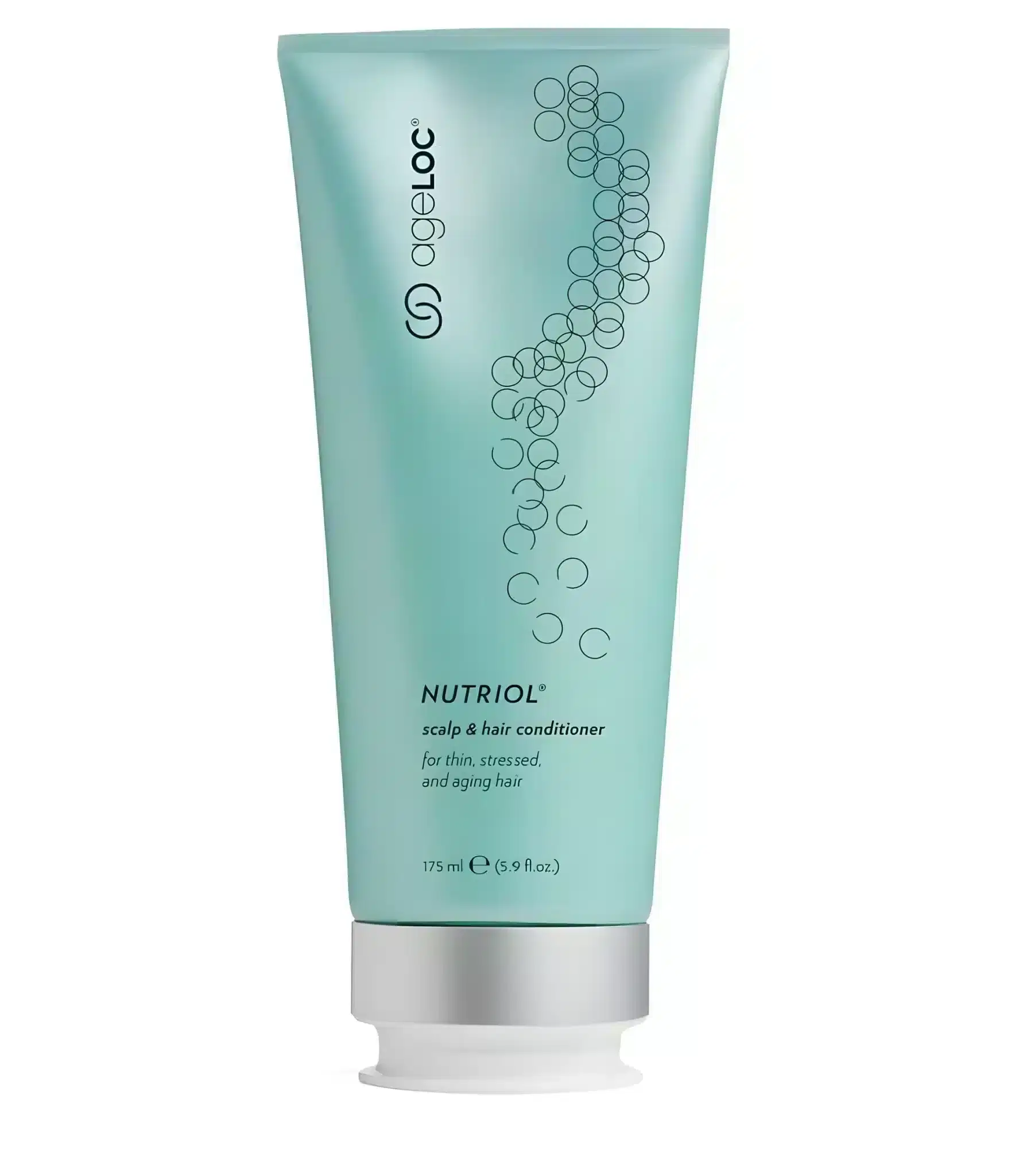
ageLOC® Nutriol® Scalp & Hair Conditioner (AU)
Product Description
The ageLOC® Nutriol® Scalp & Hair Conditioner is the second step in Nu Skin's Nutriol scalp health system — engineered specifically for fine and thinning hair where conventional conditioning creates more problems than it solves. Most standard conditioners achieve smoothness and detangling by loading the hair shaft with silicones and heavy emollients; on fine or thinning hair, this coating flattens volume and makes thin strands look even thinner. The Nutriol Conditioner takes a different approach: it conditions through hydrolysed wheat protein that penetrates the cortex to strengthen and thicken individual strands from within, while avoiding the silicone loading that compromises volume. All products ship from the official Nu Skin Australia warehouse. For the complete three-step system, see the ageLOC Nutriol Scalp & Hair System.
What Makes This Different from Standard Conditioners
The central challenge of conditioning fine or thinning hair is a genuine trade-off: the hair needs moisture and detangling support, but the standard way of delivering it — silicone coating — removes the volume that fine-haired people are trying to preserve. The Nutriol Conditioner solves this by replacing dimethicone and cyclomethicone with hydrolysed wheat protein molecules that are small enough to penetrate the hair cortex (the structural core of each strand) rather than sitting on the surface.
Once inside the cortex, these protein fragments bind to internal protein structures and increase strand diameter by an estimated 5–10%. This creates genuine body: the hair is physically thicker at the strand level, rather than coated in a film that washes off with the next shampoo. The effect is cumulative — regular use over 4–6 weeks produces noticeably thicker-feeling hair as protein reinforcement builds up across each strand. This is why the Nutriol Conditioner feels different from other "volumising" conditioners: there is nothing coating the outside, but the inside of each strand is progressively stronger and fuller.
Key Ingredients
Hydrolysed Wheat Protein — low molecular weight protein fragments that penetrate the hair cortex to bond to damaged or thinned internal structures. Increases strand diameter by an estimated 5–10% with regular use. The primary volumising and strengthening mechanism in this conditioner — structural thickening, not surface coating.
Nutriol Complex — the shared botanical ingredient system across the Nutriol range. Delivers scalp-supporting trace minerals and extracts during the conditioning step, complementing the Tricalgoxyl action of the shampoo and serum.
Panthenol (Pro-Vitamin B5) — lightweight humectant that attracts and retains moisture within the hair shaft without creating surface weight. Converts to vitamin B5 inside the strand, improving internal hydration and adding subtle shine by smoothing the cuticle layer from within.
Glycerin — humectant that draws atmospheric moisture into the hair shaft. Works particularly well along Australia's humid coastal zones (Sydney to Cairns) where atmospheric moisture is readily available. In drier inland environments, use a small amount to avoid potential hygroscopic over-absorption.
No heavy silicones — the formula avoids dimethicone and cyclomethicone. These standard mass-market conditioner ingredients create instant smoothness but build up on fine hair over time, requiring progressively stronger (more stripping) shampoos to remove — a cycle the Nutriol system deliberately avoids.
Nutriol Conditioner vs. Nu Skin Smoothing Conditioner: Which Line Is Right
Both are Nu Skin conditioners available through NuBest Skin AU, but they serve fundamentally different hair concerns:
| Feature | Nutriol Conditioner (AU$45) | Smoothing Conditioner (AU$22) |
|---|---|---|
| Primary concern addressed | Hair thinning, volume loss, scalp health | Frizz, unruly texture, heat/chemical damage |
| Best hair type | Fine, thin, or volume-challenged | Thick, coarse, frizzy, or damaged |
| Key active | Hydrolysed wheat protein (cortex penetration) | Shea butter + meadowfoam seed oil (surface lipid replenishment) |
| Mechanism | Internal strand thickening from cortex up | Cuticle sealing and lipid replenishment from outside in |
| Silicone loading | None (deliberately avoided) | Minimal, water-soluble |
| Part of a scalp health system | ✓ Nutriol 3-step system | ✗ Standalone everyday product |
If your hair is fine and you are concerned about thinning or volume loss — Nutriol. If your hair is thick, coarse, or frizzy and you want smoothness and manageability — the Smoothing Conditioner. These are not competing products; they address genuinely different hair types and concerns.
How Australians Are Using Nutriol Conditioner
For fine-haired Australians, conditioning is often the most anxiety-inducing step in hair care. Too much product, the wrong formula, or application at the roots creates the flat, weighed-down look that fine-haired people dread. The application method matters with this conditioner: use mid-lengths to ends only, approximately a 20-cent coin amount for shoulder-length hair, leave for 1–2 minutes (no longer is needed — the proteins absorb quickly), then rinse thoroughly.
In Australia's coastal regions where humidity is year-round, the glycerin in the formula draws atmospheric moisture into the strand throughout the day — adding body and resilience that holds better than the temporary lift from a volumising mousse. In drier inland climates (Perth, Adelaide, inland NSW), use a slightly smaller amount to prevent over-absorption in very low-humidity conditions.
Who It's For
✅ Best suited for: Fine, thinning, or volume-challenged hair that needs conditioning without losing lift. Colour-treated fine hair where SLS-free conditioning is essential. Anyone who has found standard conditioners leave their hair flat. Those following the Nutriol 3-step system where this is the designated second step.
⚠️ Less suited for: Thick, coarse, or frizzy hair that needs intensive lipid replenishment (the Smoothing Conditioner is more appropriate). Hair that is severely damaged from chemical processing and needs a deep conditioning mask (supplement with the Renu Hair Mask 1–2 times weekly).
💡 Pairs well with: The ageLOC Nutriol Shampoo (AU$45) as the matching wash step. The Nutriol Serum (AU$69) as the third daily leave-in step. The Renu Hair Mask (AU$33) as a weekly substitute for the conditioner step on deep-treatment days.
Works With
ageLOC Nutriol Shampoo — the matching first step in the Nutriol routine. The shampoo's sulphate-free cleanse removes build-up and deposits Tricalgoxyl at the scalp; the conditioner follows with protein-based strand strengthening for a complete wash-day treatment.
Renu Hair Mask — use in place of this conditioner 1–2 times per week for intensive repair. The mask's CS7 complex and hydrolysed keratin address visible hair length damage that the conditioner's lighter formula does not fully address. Do not use both in the same wash session.
Frequently Asked Questions
Why does the Nutriol Conditioner cost more than the Smoothing or Volumizing conditioners?
The Nutriol range contains specialised actives — Tricalgoxyl, ageLOC blend, hydrolysed wheat protein at cortex-penetrating molecular weight — designed for scalp health and hair thinning support. The Smoothing and Volumizing conditioners (AU$22 each) are everyday hair care for texture management. Different formulation complexity, different price tier, different purpose.
Should I apply this conditioner to the scalp?
No. Apply from mid-lengths to ends only. The scalp treatment is handled by the Nutriol Serum, which is specifically formulated for scalp-level application. Applying conditioner to the scalp of fine hair typically reduces volume and can contribute to product build-up at the roots.
How long should I leave the conditioner in before rinsing?
1–2 minutes is sufficient. Hydrolysed wheat protein absorbs quickly into the cortex — extended leave time does not significantly improve penetration. Rinse thoroughly to avoid any residue that could weigh down fine hair.
Can I use this conditioner without the Nutriol Shampoo?
Yes. The conditioner works with any sulphate-free shampoo. The full benefit of shared Tricalgoxyl and ageLOC actives is realised when using the complete Nutriol system, but the conditioner's protein-based thickening works independently of the specific shampoo used.
Is this conditioner suitable for hair extensions or wigs?
The formula is compatible with most synthetic-blend hair extensions. Avoid application at bond/tape points, as conditioning agents can loosen adhesive bonds. For fully synthetic hairpieces, consult your extension supplier before use.
How long before I notice a difference?
Hair feel and detangling ease improve within the first week. The cumulative protein-thickening effect — where strand diameter measurably increases — builds over 4–6 weeks of regular use. Daily use produces the best outcome; intermittent use extends the timeline without building cumulative benefit as effectively.
Sources & References
- Nu Skin Enterprises — ageLOC Nutriol Conditioner product information. nuskin.com/au
- Sederma (Croda International) — Tricalgoxyl and Nutriol complex technical data. sederma.fr
- Madnani N & Khan K. "Hair cosmetics." Indian Journal of Dermatology, Venereology and Leprology, 2013. DOI: 10.4103/0378-6323.110734
NuBest Skin is an Independent Nu Skin Brand Affiliate. This website is independently operated and is not produced, endorsed, or approved by Nu Skin Enterprises, Inc.
Author: NuBest Skin Editorial Team
Why Buy from NuBest Skin?
No registration needed — shop and purchase directly, no account setup required.
Shipped from official Nu Skin warehouse — 100% authentic, factory-sealed products with full warranty.
Competitive pricing — we offer great value on authentic Nu Skin products.
Nu Skin product purchasing channels for Australia -- relationship, invoice, warranty, warehouse fulfilment, and marketplace-risk guidance.