
2 April 2026
The Micronutrient Gap: Why Most British Adults Don't Get Enough from Food Alone

According to the UK's National Diet and Nutrition Survey (NDNS), one in four British adults has vitamin D levels below the recommended threshold. Iron deficiency affects 27% of women aged 19–64. And selenium intake has been declining across the UK population for two decades. These aren't fringe numbers — they come from the government's own rolling dietary assessment programme, which has been tracking what we actually eat since 2008.
We've spent three months looking at the research on micronutrient deficiency in the UK, comparing supplement options, and testing one of the more comprehensive formulas on the market. Here's what we found — and honestly, some of it surprised us.
Why most British adults have micronutrient gaps
The NDNS data paints a clear picture. Across all adult age groups, average intakes of vitamin D, selenium, iron (in women), magnesium, potassium, and folate fall below the Reference Nutrient Intake (RNI). This isn't about people eating badly — even those following what they'd consider a balanced diet often come up short. Modern farming, longer food supply chains, and the reality of British winters (we average just 1,500 hours of sunshine per year, compared to 2,500 in southern France) all contribute.
The NHS recommends all adults consider a 10µg vitamin D supplement from October to March. But vitamin D is just one piece of a much larger puzzle. Selenium levels in UK soil have dropped steadily since the 1970s when we switched from American to European wheat — a change that reduced the selenium content of bread by roughly 50%, according to research published in The Lancet.
The bioavailability problem with cheap supplements
Not all supplements are created equal, and this is where most consumer guides stop short. The form a nutrient takes matters enormously. Magnesium oxide, for example — commonly used in budget multivitamins because it's cheap — has a bioavailability of around 4%, according to a 2001 study in the Journal of the American College of Nutrition. Magnesium citrate, by contrast, is absorbed at roughly 25–30%.
The same principle applies across the board. Vitamin E as synthetic dl-alpha-tocopherol is roughly 50% less bioavailable than the natural d-alpha form. Folate as methylfolate bypasses the MTHFR conversion step that an estimated 10–15% of the UK population struggles with genetically. Zinc as zinc picolinate is absorbed more efficiently than zinc oxide.
We looked at the supplement labels of five popular UK high-street multivitamins and found that four of the five used the cheaper, less bioavailable forms of at least three key nutrients. The price difference at the ingredient level is real — better forms cost manufacturers more — but the difference to you is whether you're actually absorbing what the label promises.

How to read a supplement label: what to look for
A good multivitamin label should tell you three things: what nutrients are included, in what form, and at what dose relative to the Nutrient Reference Value (NRV). Here's what we check first:
- Vitamin D3 (cholecalciferol), not D2 — D3 is the form your skin produces naturally and is 87% more effective at raising blood levels, per a 2012 meta-analysis in the American Journal of Clinical Nutrition
- Methylfolate, not folic acid — the bioactive form that doesn't require enzymatic conversion
- Chelated minerals (citrate, glycinate, picolinate) rather than oxides and carbonates
- Full B-complex at meaningful doses — many budget formulas include B vitamins at just 100% NRV, which may not be optimal for energy metabolism support
- Antioxidant blend — vitamins C and E plus selenium at minimum; bonus for carotenoid diversity
Third-party testing is another marker. Any manufacturer can print numbers on a label. Fewer submit to independent verification. Look for GMP (Good Manufacturing Practice) certification at minimum.
The vitamin D, K2, magnesium triangle — why bone health needs all three
Most people know calcium matters for bones. Fewer know that vitamin D is essential for calcium absorption — without adequate D, you absorb as little as 10–15% of dietary calcium, according to the National Osteoporosis Society. Even fewer know that vitamin K2 directs calcium to bones rather than allowing it to deposit in arteries, and that magnesium is required to convert vitamin D into its active form.
This is why isolated calcium supplements have produced mixed results in clinical research. A 2015 meta-analysis in the BMJ found that calcium supplements alone didn't consistently reduce fracture risk. The trio of D3, K2, and magnesium alongside calcium is what the evidence supports — and it's what a well-designed multivitamin should include.
In our view, any multivitamin that contains calcium but skips K2 is outdated in its formulation. The research on K2's role has strengthened considerably over the past decade.
9 Body Functions Supported by LifePak+
Based on EFSA-approved health claims for the vitamins and minerals contained in LifePak+.
Where LifePak+ fits — and how it compares
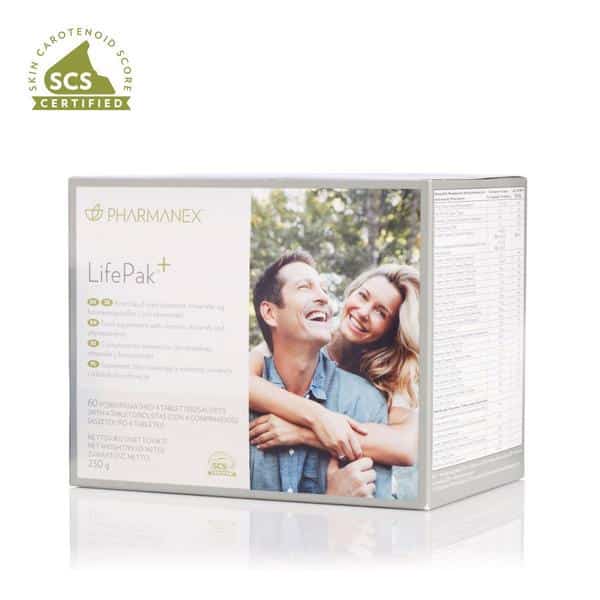
Pharmanex LifePak+ is one of the more comprehensive multivitamin formulas we've tested. It contains over 20 essential vitamins and minerals delivered in a dual-sachet format — one sachet of tablets and one of soft-gel capsules. The separation matters: fat-soluble nutrients (A, D, E, K) are delivered in the soft-gel for better absorption alongside dietary fats, while water-soluble vitamins (B-complex, C) are in the tablet.
Pharmanex holds SCS (Supplement Certified by NSF) certification, which involves independent lab testing of finished products — not just ingredient verification. This puts it in a smaller category than most consumers realise. Honestly, when we first looked at the certification, we assumed it was just another logo. The SCS programme actually tests products off the shelf, unannounced, at retail — which is a stricter standard than most in-house testing.
| Criteria | LifePak+ | Vitabiotics Wellman/Wellwoman | Holland & Barrett Complete | Centrum Advance |
|---|---|---|---|---|
| Number of nutrients | 20+ | 24 | 18 | 24 |
| Format | Dual sachet (tablet + soft-gel) | Single tablet | Single tablet | Single tablet |
| Antioxidant blend | Yes (C, E, selenium, carotenoids) | Yes (C, E, selenium) | Limited | Yes (C, E) |
| Third-party certified | SCS (NSF) | GMP | GMP | GMP |
| Bioavailability design | Fat/water-soluble separated | Combined tablet | Combined tablet | Combined tablet |
Is a multivitamin worth it if you eat well?
This is the question we get most often — and the honest answer is: probably, yes. The NDNS data doesn't just track people eating badly. Even in the highest-quality diet quintile, vitamin D and selenium intakes remain below recommended levels for the majority. The British Dietetic Association acknowledges that food alone may not meet all micronutrient needs, particularly for vitamin D, and the NHS actively recommends supplementation from October through March.
Supplementation doesn't replace food. A capsule won't give you the fibre, phytochemicals, and satisfaction of a proper meal. But for filling specific, well-documented gaps — particularly D, selenium, and B12 for those over 50 — the evidence supports it.
Frequently asked questions
Do most British adults actually need a multivitamin?
Based on NDNS data, the majority of UK adults are deficient in at least one micronutrient, most commonly vitamin D, selenium, and iron (women). A comprehensive multivitamin addresses multiple gaps simultaneously rather than requiring separate supplements for each.
How is LifePak+ different from a supermarket multivitamin?
The dual-sachet format separates fat-soluble and water-soluble nutrients for better absorption. LifePak+ holds SCS certification from NSF International, which involves independent off-the-shelf testing — a stricter verification standard than standard GMP alone.
Can I take LifePak+ with other medications?
If you're on prescription medication — particularly blood thinners, thyroid medication, or immunosuppressants — consult your GP before starting any multivitamin. Vitamin K, for instance, can interact with warfarin.
Why does LifePak+ come in sachets instead of a single tablet?
Fat-soluble vitamins (A, D, E, K) absorb better when delivered in a soft-gel with lipids. Water-soluble vitamins (B-complex, C) don't need this. Separating them into two formats within each sachet optimises absorption of both types.
Is iodine deficiency common in the UK?
Yes. A 2011 study in The Lancet classified the UK as mildly iodine-deficient, particularly among teenage girls and young women. Iodine is essential for thyroid function, and LifePak+ includes it as part of its mineral profile.

Food supplements should not be used as a substitute for a varied and balanced diet and a healthy lifestyle. Do not exceed the recommended daily dose. Keep out of reach of young children. This product is not intended to diagnose, treat, cure, or prevent any disease.
Nutritional data sourced from the UK National Diet and Nutrition Survey (2019–2022 rolling programme), NHS guidance on vitamin D supplementation, and EFSA-approved health claims register. Product information from official Nu Skin Pharmanex documentation.
Independent Nu Skin Brand Affiliate — not produced or endorsed by Nu Skin Enterprises Inc.