
18 March 2026
Weight Management Science: How the TRMe System Supports Sustainable Results

Ireland's Relationship with Weight — A Complicated Story
We Irish have a complicated relationship with food and weight. The Healthy Ireland Survey — conducted annually by the Department of Health — consistently reports that around 60% of Irish adults are overweight or obese. The CSO (Central Statistics Office) data tells a similar story, placing Ireland well above the EU average of roughly 50.6%. By 2030, obesity alone is projected to affect up to 36% of Irish adults, which would make us the third-highest rate in Europe.
Overweight Adults in Ireland vs EU Average (Eurostat 2022)
Source: Eurostat 2022 EHIS / CSO Ireland
Some of this comes down to culture. The traditional Irish diet is hearty — coddle, stew, colcannon, soda bread, the full Irish breakfast. These are comfort foods built for cold, wet days and hard physical work. The problem is that most of us aren't farming or labouring the way our grandparents did, but the portions and the calorie density haven't adjusted to match. Add in our pub culture (Ireland consistently ranks among the highest per-capita alcohol consumers in the EU), and you have a population that's genuinely struggling with energy balance.
The HSE's Healthy Ireland framework has pushed awareness in the right direction. The GAA's Healthy Club Programme, which now covers over 300 clubs nationwide, has done genuinely good work at community level. But awareness alone hasn't shifted the numbers. The INDI (Irish Nutrition and Dietetic Institute) keeps publishing sensible guidelines about gradual, sustainable weight loss — 0.5 to 1 kg per week — yet the gap between what people know and what they manage to sustain in practice remains stubbornly wide.
We've spent the past year looking closely at why that gap persists, and the answer isn't willpower. It's biology.

Why Weight Loss Programmes Often Fall Short
Here's a scenario most Irish people know well. You start a new eating plan in January — motivated, disciplined, meal-prepped. By March, the weight loss has stalled despite eating the same reduced calories. By May, most of the weight is back. The Healthy Ireland Survey 2023 found that while 50% of adults had tried to lose weight in the previous year, fewer than 15% maintained their results beyond six months.
The reason isn't laziness. Five distinct biological mechanisms are working against conventional dieting, and understanding them changes how you approach the entire problem.
Metabolic adaptation is the first wall people hit. When you reduce calorie intake, your body responds by lowering its resting metabolic rate — essentially burning less energy to match the reduced supply. Research published in the journal Obesity (Fothergill et al., 2016) tracked individuals who had lost significant weight and found their metabolisms had slowed by an average of 500 calories per day below what would be expected for their new body size, and this suppression persisted for at least six years. Your body literally fights to regain the weight.
Muscle loss during dieting compounds the problem. Studies published in the American Journal of Clinical Nutrition indicate that 20-40% of weight lost through calorie restriction alone can be lean tissue rather than fat. Muscle is metabolically expensive to maintain — it burns calories even at rest. Lose muscle, and your metabolic rate drops further, creating a self-reinforcing cycle that makes every subsequent diet attempt harder than the last.
Gut health is another factor that rarely gets the attention it deserves. The INDI has increasingly highlighted the role of digestive function in weight management. A 2019 review in Nutrients established that gut microbiome composition differs meaningfully between lean and overweight individuals, affecting everything from calorie extraction efficiency to fat storage signalling. If your digestive system isn't functioning well, it doesn't matter how carefully you count your macros.
Liver function is perhaps the most overlooked piece. Non-alcoholic fatty liver disease (NAFLD) affects approximately 25% of the European population according to the European Association for the Study of the Liver, and Irish rates are thought to be higher given our alcohol consumption patterns and dietary habits. The liver is your central fat-processing organ. When it's burdened — whether from excess fat, alcohol, or both — its ability to metabolise dietary and stored fat drops significantly.
Blood sugar instability drives the cravings that derail even the most determined efforts. The classic Irish tea break — a cup of tea with biscuits or a scone — creates a glucose spike followed by a sharp drop, triggering hunger within two hours. This isn't a character flaw; it's biochemistry. Chromium, which contributes to normal blood glucose maintenance, is one of the nutrients specifically relevant here, and most Irish adults don't get optimal amounts from diet alone.
The INDI guidelines acknowledge this complexity. Their position papers increasingly reference the multi-factorial nature of weight regulation, moving away from the old "calories in, calories out" simplification. The evidence is clear: addressing just one of these factors while ignoring the rest is why most programmes deliver temporary results at best.
Rethinking Weight Management — A Multi-Factor Approach
If five interconnected systems are sabotaging conventional dieting, then the logical response is to support all of them simultaneously. Not with a single magic ingredient, but with a coordinated nutritional strategy that addresses each failure point.
We've been following the research in this space for over a year now, and the most credible approaches we've encountered share four characteristics:
First, metabolic support during reduced calorie intake. Rather than letting the body's survival mechanisms stall your progress, you provide nutritional support that helps maintain normal energy metabolism even while eating less. This means specific vitamins and minerals that contribute to energy-yielding metabolism — not stimulants, not thermogenics, but the cofactors your body needs to keep burning fuel efficiently.
Second, appetite regulation through blood sugar stability. Instead of relying on willpower to resist cravings, you address the glucose fluctuations that cause them in the first place. Stable blood sugar throughout the day means fewer energy crashes, less impulsive eating, and a more sustainable calorie intake — without feeling deprived.
Third, digestive support. A healthy gut processes food more efficiently, absorbs nutrients more effectively, and communicates better with the hormones that regulate hunger and satiety. During any dietary change, supporting digestive comfort makes the transition smoother and the outcomes more reliable.
Fourth, liver and fat metabolism support. Given how central the liver is to fat processing, and how widespread sub-clinical liver stress has become in Ireland, supporting hepatic function during weight management is practical common sense, not optional supplementation.
This multi-pillar framework isn't something we invented. It's emerging from the convergence of metabolic research, gut microbiome science, and hepatology. The question is whether any commercial product actually implements it properly — with ingredients that carry genuine scientific backing rather than marketing claims.
The ageLOC TRMe System — Science in Practice
Nu Skin's ageLOC TRMe is one of the few weight management systems we've encountered that genuinely maps to the four-pillar approach. It's not a single supplement or a meal replacement — it's four distinct products, each formulated to address one specific aspect of the weight management puzzle, designed to be used together.
The 4 Pillars of the TRMe System
Weight Management
Glucomannan + Vitamins C, B6, B12
Appetite Control
Mulberry Leaf + Carob + Chromium
Digestive Support
Artichoke Leaf + Ginger Root
Liver & Fat Metabolism
Turmeric + Moringa + Curry Leaf
MyGoal — The Foundation
MyGoal centres on glucomannan, a natural dietary fibre derived from konjac root. This ingredient holds an EU-approved health claim: glucomannan contributes to weight loss in the context of an energy-restricted diet, when taken as 3g per day in three 1g doses, each with one to two glasses of water before meals. The mechanism is straightforward — glucomannan absorbs water and expands in the stomach, promoting fullness and helping you eat less at each sitting.
Alongside the fibre, MyGoal provides vitamins C, B6, and B12, all of which carry EU-approved claims for contributing to normal energy-yielding metabolism. During caloric restriction, when energy tends to flag, this metabolic support is genuinely useful — not a stimulant effect, but the nutritional building blocks your body needs to keep producing energy efficiently. Vitamin B6 also contributes to the regulation of hormonal activity, which matters during any period of dietary change.
MyEdge — Addressing the Craving Cycle
If MyGoal is the foundation, MyEdge is the component that tackles the day-to-day sabotage of cravings and energy dips. It combines white mulberry leaf extract, traditionally associated with blood sugar support, with carob extract, which supports feelings of appetite satisfaction and satiety. Chromium rounds out the formula — it contributes to the maintenance of normal blood glucose levels, an EU-approved claim that's directly relevant to breaking the spike-and-crash cycle.
Honestly, this is the product in the system that we think most Irish people would notice first. Between the tea-and-biscuit habit, the mid-morning scone, and the after-dinner treats, blood sugar instability is driving a significant portion of excess calorie intake in this country. Address that, and the downstream effects on eating behaviour can be substantial — without requiring an iron will.
InnerNu — Gut Support During Dietary Change
InnerNu takes a gentler approach with artichoke leaf extract and ginger root extract. Artichoke has a long history of traditional use for digestive comfort, and ginger root may support normal digestive function. It's the quietest member of the system, but arguably one of the more important ones. Any change in eating patterns can cause temporary digestive disruption, and supporting gut health during that transition helps everything else work more effectively.
Worth noting: if you have IBS or other existing digestive conditions, have a chat with your GP before adding new supplements to your routine. This is sensible advice for any supplement, not specific to InnerNu.
RealMe — Supporting the Liver
The fourth pillar is RealMe, built around turmeric extract, which carries an EU-context claim that it prevents fat accumulation and facilitates breakdown of fats by the liver. Moringa and curry leaf extract provide additional botanical support. Given Ireland's rates of alcohol consumption and the dietary patterns we discussed earlier, liver support during a weight management programme isn't a nice-to-have — for many Irish adults, it's addressing a genuine metabolic bottleneck.
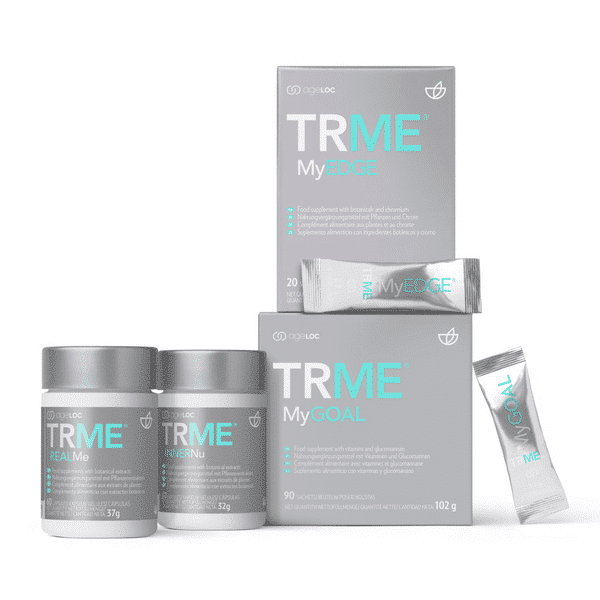
ageLOC TRMe Weight Management Kit — available for Ireland

Getting Started — A Practical Guide
The TRMe system fits around your regular meals. There's no meal replacement element, no exclusion lists, and no requirement to overhaul your diet overnight. Here's what a typical day looks like in practice:
Before breakfast: Take one dose of MyGoal (1g glucomannan) with one to two large glasses of water. This is important — the fibre needs adequate water to expand properly in the stomach. Then have your normal breakfast. (Yes, even porridge with a bit of honey counts as a perfectly good option.)
Before lunch: Second dose of MyGoal with water, plus MyEdge. The combination supports satiety through the afternoon — that dangerous stretch between lunch and dinner when most unplanned eating happens. If you're someone who reaches for the biscuit tin at 3pm, this is the dose that should make the biggest difference.
Before dinner: Third dose of MyGoal with water. Take InnerNu to support digestion. RealMe can be taken with any meal — most people settle on dinner for convenience.
The system includes a Body Balance Guide with detailed daily recommendations. It doesn't require calorie counting or food diaries, though it works perfectly well alongside them if that's your preference. The INDI recommends keeping a food diary when trying to manage weight — the TRMe guide complements that approach rather than contradicting it.
Set your expectations sensibly. The Healthy Ireland framework and INDI both recommend gradual, sustainable progress rather than rapid weight loss. TRMe is designed to support exactly that kind of measured approach. Most people we've spoken to find the routine becomes second nature within a week, and the Body Balance Guide helps track progress without the daily weigh-in anxiety that tends to do more harm than good.
One thing we particularly appreciate: you eat real food. No branded shakes, no proprietary bars (those exist separately if you want them, but they're not part of the core system). The philosophy is supplementation alongside a balanced diet, not substitution for one.
Common Questions
Is TRMe compatible with an active GAA or sports training schedule?
Yes, and this is something we've had quite a few questions about from readers in Ireland. TRMe doesn't contain stimulants, banned substances, or anything that would interfere with athletic performance. The MyGoal glucomannan doses should be taken 30 minutes before meals (not immediately before training), and you'd want to ensure your overall calorie intake still supports your training demands. If you're doing intense GAA training three or four times a week, you may not need aggressive calorie restriction at all — the TRMe system can support body composition goals even with moderate dietary adjustments. Chat with your coach or a sports nutritionist if you're in serious competition training.
Does it work alongside a traditional Irish diet, or do I need to eat completely differently?
You don't need to abandon coddle or stop eating brown bread. The TRMe system is designed to complement your existing diet, not replace it. That said, if your current diet is very calorie-dense (large portions of stew followed by dessert, full Irish every morning), the system works best when combined with sensible adjustments — smaller portions, fewer high-sugar snacks, less alcohol. The INDI recommends a Mediterranean-style dietary pattern as optimal, but realistic improvements to a typical Irish diet will still produce results when combined with TRMe's metabolic support.
Can I buy TRMe products individually, or is the full kit better value?
The products are available individually, but the system is specifically designed as a four-pillar programme. Buying the full kit ensures you're addressing all the factors simultaneously, which is the scientific rationale behind TRMe's design. If you had to choose one product as a starting point, MyGoal has the strongest standalone EU health claim (glucomannan for weight loss in the context of an energy-restricted diet). But we'd genuinely recommend the complete system — supporting only one or two pillars while leaving the others unaddressed is essentially doing half the job.
Are the TRMe products suitable for vegetarians and vegans?
Three of the four products — MyGoal, MyEdge, and RealMe — carry V-Label vegan certification. InnerNu uses a capsule shell containing gelatin, making it vegetarian-friendly but not vegan. Nu Skin has been straightforward about this on their packaging. If you follow a strictly vegan diet, you could use the three vegan products and look into a separate plant-based digestive support supplement to cover the fourth pillar.
How does TRMe compare to other weight management supplements available in Ireland?
We're not going to name competing products — that's not our style. What we will say is that the differentiator with TRMe is the multi-target approach. Most weight management supplements focus on a single mechanism: appetite suppression, or metabolism boosting, or fat burning. TRMe addresses four distinct biological systems simultaneously, and every active ingredient either carries an EU-approved health claim or has established traditional use. That's a higher evidence bar than much of what's on pharmacy shelves. The fact that it's a system rather than a single pill is both its greatest strength and its main barrier — it requires more commitment than popping one tablet, but the scientific logic is considerably more sound.
If you've been through the cycle of January motivation and March disappointment, and you're ready to try an approach that actually accounts for why diets fail, the TRMe system is worth your time.
Explore the TRMe Weight Management Kit →
Product information sourced from official Nu Skin product documentation and the EU Register of Nutrition and Health Claims. Sources referenced: Healthy Ireland Survey (Department of Health), CSO Ireland, Eurostat EHIS 2022, INDI position papers, Fothergill et al. (2016) Obesity, European Association for the Study of the Liver NAFLD guidelines.
Food supplements should not be used as a substitute for a varied and balanced diet and a healthy lifestyle. Do not exceed the recommended daily dose. Consult your healthcare provider before starting any new supplement programme.
NuBest Skin is an Independent Nu Skin Brand Affiliate. This website is independently operated and is not produced, endorsed, or approved by Nu Skin Enterprises, Inc.