Authorised Independent Nu Skin Distributor
Sunright SPF 35 (Ireland/EU)
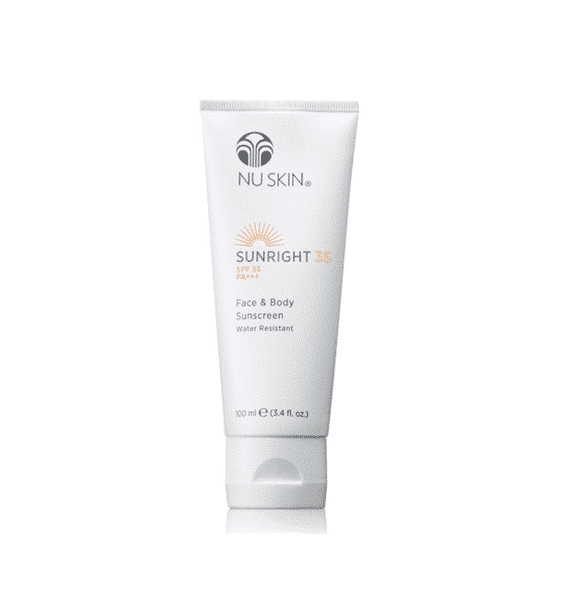
Product Description
The Everyday Sunscreen for Irish Weather — When the Sun Arrives Without Warning
You're walking from Heuston Station to your office on a grey Dublin Tuesday when the clouds part unexpectedly and the April sun appears with surprising intensity. You haven't packed sunscreen. Sunright SPF 35 is built for exactly this reality — Irish sun exposure that arrives unpredictably, often on overcast days when UV still penetrates cloud cover. This lightweight, body-friendly broad-spectrum sunscreen is designed for daily incidental exposure: the school run in Limerick, a lunchtime walk along Cork's South Mall, or a blustery afternoon at Galway's Spanish Arch. At €21.00, it's the kind of sunscreen you keep in your bag from March through October, so you're never caught off-guard by an Irish sun that doesn't announce itself.
Best suited for:
- Daily commuters and those with regular incidental outdoor exposure (30–90 minutes)
- Families looking for an affordable everyday body sunscreen for spring and summer
- Pale Irish complexions that burn quickly even in moderate UV conditions
- Anyone who wants comfortable, non-greasy sun protection without the heaviness of a higher SPF formula
Less suited for:
- Extended beach days, outdoor sports, or prolonged direct sun exposure — step up to Sunright SPF 50 (€23.00) for those occasions
- Those seeking a dedicated facial sunscreen with a feather-light, mattifying finish
Pairs well with:
- Sunright SPF 50 — for face and high-exposure areas on sunny days
- Sunright Insta Glow Tinted Self-Tanning Gel (€32.00) — for colour on days when the Irish sun doesn't deliver
- Dew All Day Moisture Restore Cream (€40.00) — for post-sun rehydration
What Makes Sunright SPF 35 Different
SPF ratings can feel like a numbers game, but the science behind SPF 35 and its real-world application in an Irish climate is worth understanding clearly.
Broad-Spectrum UVA/UVB Coverage
Sunright SPF 35 provides combined protection against both UVA rays (responsible for premature skin ageing and deeper tissue damage) and UVB rays (the primary cause of sunburn). SPF 35 blocks approximately 97% of UVB rays — a figure that often surprises people who assume only SPF 50 provides meaningful protection. The practical gap between SPF 35 (97% UVB blocked) and SPF 50 (98% UVB blocked) is just one percentage point. For everyday Irish outdoor activity where you're not in prolonged direct sun, that margin is negligible.
Lightweight Body Formula
This formula is engineered for body application — spreading easily over larger surface areas like arms, legs, and chest without pilling on clothing or leaving the chalky, heavy residue that puts many people off reapplying. Ireland's changeable weather means you might layer this under a light rain jacket or lightweight jumper; the non-greasy finish makes that practical.
Conditioning Agents for Comfort
Some sunscreens leave skin feeling tight or dry after application — a particular issue in Ireland's wind-exposed conditions (coastal walks, school drop-offs in a breeze). Sunright SPF 35 includes conditioning agents that help maintain skin comfort during wear, so protection doesn't come at the cost of comfort.
The Irish UV Reality
According to the Irish Cancer Society, UV radiation reaches the skin even on cloudy days — cloud cover only reduces UV by approximately 10–20%. The HSE recommends daily sun protection from March through October. SPF 35 is well-positioned as the everyday practical choice for this kind of consistent, year-round low-to-moderate UV exposure that characterises the Irish climate.
SPF 35 vs SPF 50: An Honest Comparison
SPF 35 blocks ~97% of UVB. SPF 50 blocks ~98%. The difference is real but small. Where SPF 50 earns its place: extended beach days (a trip to Inchydoney or a summer holiday in the Algarve when Irish skin rarely sees strong UV), prolonged outdoor sports, or very fair complexions prone to burning within minutes. Where SPF 35 works well: everyday commuting, walking, outdoor dining, and activities lasting up to 90 minutes in Irish summer conditions. Both products provide broad-spectrum UVA/UVB protection.
How It Compares
| Product | SPF Level | UVA Protection | Formula Type | Key Feature |
|---|---|---|---|---|
| Sunright SPF 35 (Nu Skin) | SPF 35 (~97% UVB) | Broad-spectrum UVA/UVB | Lightweight body lotion | Conditioning agents; comfortable everyday wear |
| Vichy Ideal Soleil SPF 30 Body Milk | SPF 30 (~97% UVB) | UVA/UVB | Emulsion body lotion | Pharmacy brand; well-tested EU formula; higher water content |
| Boots Soltan Once Body Lotion SPF 30 | SPF 30 (~97% UVB) | UVA star-rated system | Standard lotion | Widely available; claims 8-hour moisture; basic UV filters |
| La Roche-Posay Anthelios SPF 30 Body Lotion | SPF 30 (~97% UVB) | Broad-spectrum; Mexoryl filter system | Lightweight lotion | Patented Mexoryl SX photostable filter; dermatologically tested for sensitive skin |
Comparison reflects publicly available formulation information. Ingredient quality and photostability vary across products; consult EU Cosmetics Regulation (EC) No 1223/2009 compliant product information for full filter details.
How to Use
Apply generously 15–20 minutes before going outdoors. For adequate body coverage, use approximately a shot-glass amount (around 35ml) — most people significantly under-apply sunscreen, which dramatically reduces the effective SPF. Reapply every 2 hours during continued sun exposure, and immediately after swimming or heavy sweating. In Ireland's changeable spring weather, keep a tube in your bag from March onwards — those unexpected sunny spells between April showers can catch even the most prepared person off-guard.
Frequently Asked Questions
Is Sunright SPF 35 available in Ireland, and how quickly does it ship?
Yes — Sunright SPF 35 is available through NuBest Skin Ireland at €21.00 and ships from the official Nu Skin EU warehouse. Delivery to addresses across the Republic of Ireland and Northern Ireland typically takes 3–5 business days. Because it ships from within the EU, there are no customs duties or import charges. Free delivery applies on orders over €100.
Does UV actually penetrate Irish clouds — do I really need sunscreen on overcast days?
Yes. This is one of the most common misconceptions about sun safety in Ireland. Cloud cover reduces UV radiation by approximately 10–20%, not 100%. The Irish Cancer Society and the HSE both confirm that meaningful UV exposure — sufficient to cause skin damage over time — occurs on overcast days, particularly from March through October. SPF 35 is appropriate for this kind of diffuse, everyday cloud-filtered UV exposure that is the norm in Ireland rather than the exception.
Should I use SPF 35 or SPF 50 for everyday use?
For everyday incidental exposure — commuting, walking, outdoor lunch breaks, the school run — SPF 35 is appropriate for most adults. SPF 35 blocks approximately 97% of UVB rays versus SPF 50's 98%, a marginal real-world difference in normal daily conditions. If you have very fair skin that burns quickly, are spending extended time outdoors in strong sun, or are planning a summer holiday where Irish skin meets Mediterranean UV, Sunright SPF 50 gives you a more protective margin.
Is this sunscreen compliant with EU cosmetics regulations?
Sunright SPF 35 is formulated and distributed for the EU market and complies with EU Cosmetics Regulation (EC) No 1223/2009, which governs the safety assessment, permitted UV filters, and labelling requirements for sunscreens sold within the European Union and Ireland. Only UV filters on the EU's approved list (Annex VI of the Regulation) may be used in products sold in Ireland.
Can I use Sunright SPF 35 on my face?
You can apply it to the face, though the formula is optimised for body use and may feel slightly richer than a dedicated facial sunscreen. If you prefer a lighter, faster-absorbing finish on your face — particularly under makeup — consider pairing SPF 35 for body coverage with Sunright SPF 50 on the face, which has a lighter texture suited to facial skin. This two-product approach also ensures your highest-exposure areas get maximum protection.
How long does one tube last with regular use?
This depends on how much of your body you're covering and how often you're applying. With correct application (a shot-glass amount per full body application) a few times a week through Irish summer months — including weekend walks along Wicklow Head, coastal drives, or garden afternoons — a tube typically lasts 4–6 weeks. For families applying to children as well, a multi-tube approach from the start of summer makes sense.
Does sunscreen affect vitamin D absorption?
This is a question raised frequently in Ireland, given the country's already low sunshine hours and high prevalence of vitamin D deficiency. Research published in the British Journal of Dermatology indicates that real-world sunscreen use does not significantly reduce vitamin D synthesis, because most people apply less sunscreen than laboratory test amounts and don't achieve full-body coverage. The HSE recommends a balanced approach: safe sun exposure in moderation, sunscreen on high-exposure areas, and considering a vitamin D supplement — particularly during Ireland's long, dark winters when sun exposure is minimal regardless of sunscreen use.
Works Well With
- Sunright SPF 50 (€23.00) — step up to SPF 50 for face and high-burn-risk days
- Sunright Insta Glow Tinted Self-Tanning Gel (€32.00) — buildable self-tan colour for when Irish skies don't cooperate
- Dew All Day Moisture Restore Cream (€40.00) — replenish skin hydration after outdoor exposure
- Epoch Baobab Body Butter (€31.00) — intensive body moisturiser for skin recovering from wind and sun exposure
- Perennial Intense Body Moisturizer (€29.00) — everyday body moisturising to support skin barrier health
Sources & References
- HSE Sun Safety Guidance: hse.ie — Skin Cancer and Sun Safety
- Irish Cancer Society — Sun Safety: cancer.ie — Sun Safety
- EU Cosmetics Regulation (EC) No 1223/2009 — UV filter permitted list (Annex VI): eur-lex.europa.eu
- Diffey B. & Norridge Z. (2009). Reported sun exposure, attitudes to sun protection and perceptions of skin cancer risk: a survey of visitors to Cancer Research UK's SunSmart campaign website. British Journal of Dermatology. Available via: PubMed
- Product facts sourced from official Nu Skin EU documentation (2024).
*Independent Nu Skin Brand Affiliate — not produced or endorsed by Nu Skin Enterprises Inc.*
Why Buy from NuBest Skin?
No registration needed — shop and purchase directly, no account setup required.
Shipped from official Nu Skin warehouse — 100% authentic, factory-sealed products with full warranty.
Competitive pricing — we offer great value on authentic Nu Skin products.
Nu Skin product purchasing channels for Ireland -- relationship, invoice, warranty, warehouse fulfilment, and marketplace-risk guidance.